
Across age, identity, background, and lifestyle, more and more people are realizing that knitting does something tangible for their brains. It’s not just relaxing: knitting for mental health is a legitimate practice that can help relieve anxiety and improve your mood, focus, and overall well-being.
To explore how it works — and why you should try it — I spoke with Molly Grimm, founder of the social media account Knitting for Wellness.
The Science Behind Knitting and Mental Health
At its core, knitting is repetitive, rhythmic, and tactile, which is basically the perfect recipe for calming your nervous system.
Research and experts in the space have pointed to a few key things happening:
- Repetitive movement can help increase serotonin, which boosts mood
- It activates the parasympathetic nervous system (your “rest and relax” mode)
- It can lead to a flow state, that feeling where you’re fully absorbed in what you’re doing
- It gives your mind a single point of focus, which can interrupt spiraling or anxious thoughts
As Betsan Corkhill writes in Knit for Health and Wellness, knitting can help you “manage everyday life, manage change, live with fluctuations in mood, and keep stress at a healthy level.” It’s not just calming in the moment—it can actually shift how you feel about your life over time.
And honestly? Most knitters don’t need a study to tell them that. You can feel it.
Knitting vs. Meditation: A Small Experiment
I actually tried to test this myself. I used one of those meditation headbands that tracks brain activity and tells you how “calm” you are. It measures how often your mind wanders — and how readily you return to focus. So I ran a simple experiment:
- One session: knitting
- One session: simple meditation (just focusing on my breath) Results:
- Knitting: calm 61% of the time
- Meditation: calm 13% of the time
The takeaway wasn’t that knitting replaces meditation, but it does show that calm doesn’t always feel the way we expect it to. Sometimes, a busy mind paired with steady hands is exactly what your brain needs.
“Knitting can help activate the body’s relaxation response through the parasympathetic nervous system, which supports a calmer state and helps reduce stress,” said Grimm. “Some people even notice things like a lower heart rate.”
Knitting as a Mental Health Tool
For many people, including those in recovery, knitting becomes more than a hobby. It becomes a grounding tool. When you remove unhealthy coping mechanisms, you need something to fill that space.
“One of the most meaningful things to witness was how many knitters began replacing harmful habits with knitting,” said Grimm.
“It gave them something steady to focus on, something productive to work toward, and something they could feel proud of. In some cases, it even helped reduce the desire to return to substances because they were so engaged in what they were creating.”
Knitting does that in a way that’s:
- productive
- creative
- calming
- and actually sustainable
It keeps your hands busy, which helps keep your mind busy, too. But not in a chaotic way. In a structured, rhythmic, safe way.
There’s also something powerful about the process itself:
- You make mistakes, and you fix them
- You don’t like something, and you unravel it and start again
- You follow patterns, and you build new ones
As one knitter put it, when you learn new patterns, you’re also “knitting new patterns into your nervous system.”
The Mental Health Benefits of Knitting No One Talks About
“When knitting is used more intentionally as a tool, often paired with therapy techniques that help bring the mind to the present, like breath work, gratitude, or counting stitches, it can also
help interrupt overthinking. Just having something physical to focus on gives the mind somewhere to go, instead of staying stuck in the same thought patterns,” said Grimm.
“The key is giving yourself permission to go slowly and focusing less on the outcome and more on the experience,” she continued. “Over time, it evolves further still into a practice that is less about learning how to knit, and more about having something familiar to return to that slows you down.”
Beyond the obvious “it helps you relax,” knitting has some underrated mental health benefits:
It reduces decision fatigue
When you’re following a pattern, a lot of the thinking is already done. That can feel like a relief if your brain is maxed out.
It gives you visible progress
Even when life feels stuck, your project grows. You can see that something is moving forward.
It creates structure without pressure
There’s a beginning, middle, and end, but you can go at your own pace.
It helps interrupt overthinking
Counting stitches, following rows, focusing on texture gives your mind somewhere to go.
It builds patience and resilience
You will mess up. You will undo hours of work. And you’ll keep going anyway.
Community, Connection, and Not Feeling Alone
Knitting also has this quiet way of bringing people together. Whether it’s:
- knitting circles
- classes
- online communities
- or just sitting next to someone, working on your own projects
It creates space for conversation without pressure. You don’t even have to make eye contact. You can just exist in the same space, doing the same thing. And somehow, that makes it easier to open up.
People share what they’re going through—the good, the hard—and knitting just sits in the middle of it all.
The Bottom Line
“One of the most meaningful things people say about knitting isn’t “it relaxes me,” said Molly. “But rather, ‘it made me feel like myself again.”
Especially during hard times—grief, illness, anxiety, recovery—knitting becomes something steady to hold onto.
If you’re intimidated, here’s the truth: you’re probably going to be bad at it at first.
That’s normal. Knitting is awkward in the beginning. The calming part doesn’t always show up right away, either—it builds over time. Start simple. Go slow. Don’t worry about being perfect. Even five minutes a day is enough to start noticing a shift. And most importantly, let it support you, not stress you out.
“Knitting isn’t a replacement for professional care. But it can be a supportive piece alongside it,” said Grimm. “But it is a powerful tool alongside those things.”
It’s something you can do anywhere that you may be feeling fidgety:
- on the couch
- on a train
- in a waiting room
- during a hard moment
- or just because you feel like it
It keeps your hands busy, your mind grounded, and gives you something real to hold onto.
“There’s something powerful about being able to see progress,” said Grimm. “You can physically see your work growing, even when other parts of life feel slow or uncertain.”
About the Author: Helaina Hovitz Regal is a critically acclaimed journalist and author of the memoir After 9/11. With a portfolio spanning over 50 premier national outlets—including The New York Times, Forbes, and Glamour—she is a recognized authority on trauma recovery, anxiety, and adolescent resilience. A former editor for Upworthy and The Good News Network, Helaina specializes in synthesizing complex psychological topics into actionable human stories. A dedicated mental health advocate and speaker, Helaina is known for transforming difficult subjects into hopeful human stories. Follow her work on Muck Rack or LinkedIn.
Knitting for Mental Health – Frequently Asked Questions
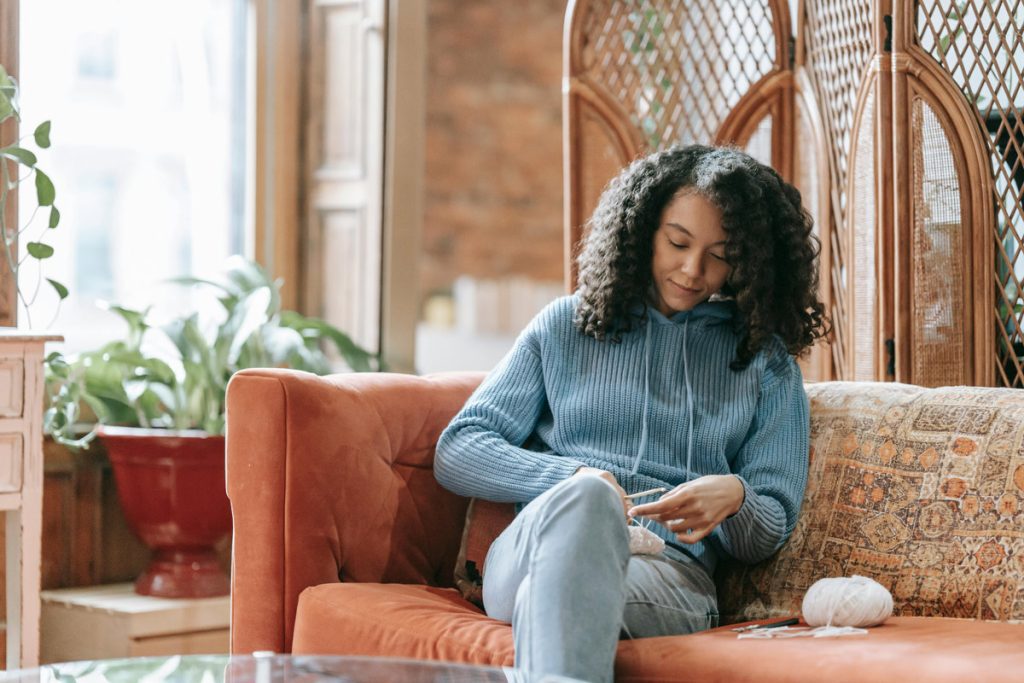
Photo by Miriam Alonso: https://www.pexels.com/photo/woman-in-blue-sweater-sitting-on-the-couch-7585541/
The opinions and views expressed in any guest blog post do not necessarily reflect those of www.rtor.org or its sponsor, Laurel House, Inc. The author and www.rtor.org have no affiliations with any products or services mentioned in the article or linked to therein. Guest Authors may have affiliations to products mentioned or linked to in their author bios.
Recommended for You